
Jiarui Li(李嘉锐)
F-building, 9th floor
Xueyuan Avenue No. 1068, Nanshan District
Shenzhen Institute of Advanced Technology, Chinese Academy of Sciences
Shenzhen, Guangdong, China
Contact
Email: lazfore[AT]gmail[DOT]com
About Me
I am currently a postdoctoral researcher at the Shenzhen Institute of Advanced Technology, Chinese Academy of Sciences. Before that, I received my Ph.D. from the Department of Electrical and Computer Engineering at Stevens Institute of Technology, where I had the honor of working with Dr. Shucheng Yu. I received my master’s degree in Business Intelligence and Technology from Stevens in May 2019. Before coming to Stevens, I received my bachelor’s degree in Applied Mathematics from South China University of Technology in 2017.
My research focuses on applied cryptography and its applications in AI security and privacy. I have also worked on lattice-based attribute-based encryption (ABE) and its applications. More broadly, I am interested in privacy-preserving computing techniques, including homomorphic encryption and multiparty computation.
Teaching Experience
- CS513 Data Mining — Teaching Assistant, Fall 2018
- CPE691 Information Security — Guest Speaker, Spring 2020 and Fall 2024
- CPE695 Applied Machine Learning — Instructor, since Fall 2023
- Retrieval-Augmented Generation — Co-Lecturer, Summer 2024 mini-course
- Privacy-Preserving Machine Learning — Co-Lecturer with York College, Summer 2025 mini-course
Research Projects
Secure Inference Outsourcing for IoT Devices
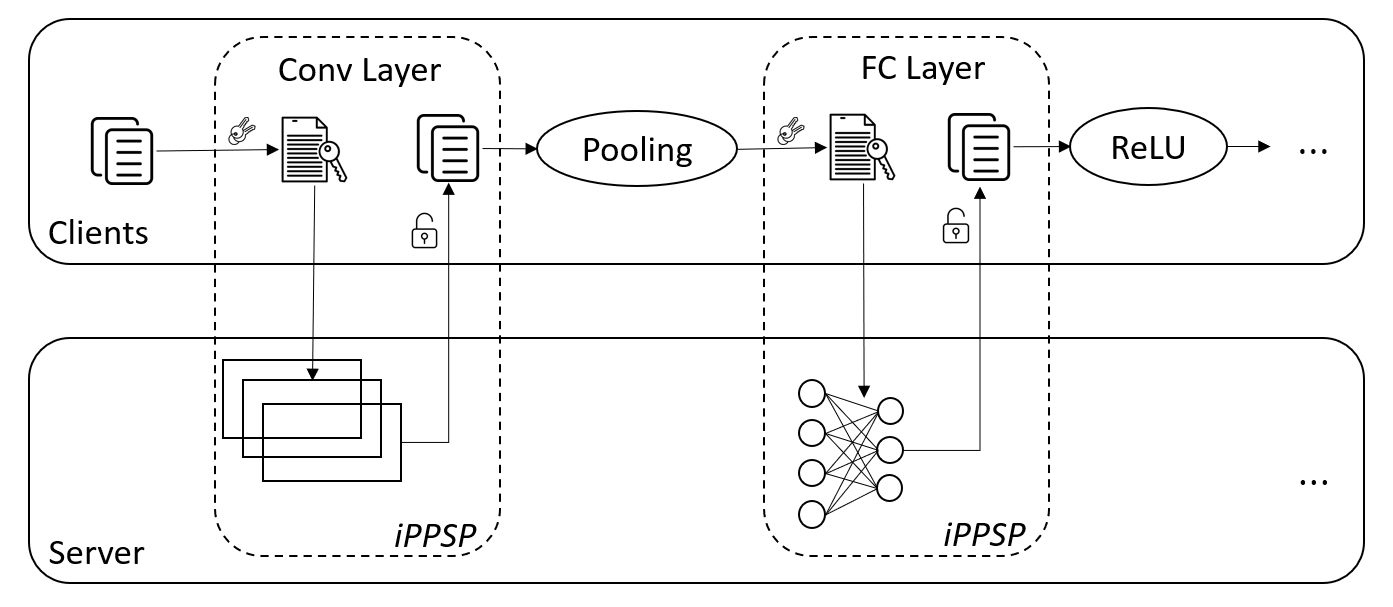
As deep learning models become increasingly complex, executing inference locally on resource-constrained devices such as IoT sensors, drones, and embedded systems has become increasingly impractical. Offloading computation to nearby edge or cloud servers offers an attractive solution, but it also raises critical privacy concerns: the data used for inference often contains sensitive personal or contextual information, and transmitting it to an untrusted server may expose users to data leakage.
To address this problem, I introduced a practical framework for secure deep neural network inference outsourcing [1] that protects input confidentiality while maintaining real-time performance, without relying on heavy cryptographic tools such as homomorphic encryption or multiparty computation. The key insight is to separate neural computations into linear and nonlinear parts. Linear layers, such as convolutional and fully connected layers, dominate the computational cost and can be securely outsourced, while nonlinear activations remain local. This design leverages the algebraic linearity of neural networks to achieve both efficiency and privacy.
To realize this idea, I developed an interactive Privacy-Preserving Scalar Product (iPPSP) evaluation primitive that enables secure linear computation outsourcing using lightweight one-time-pad encryption. The protocol ensures confidentiality under standard cryptographic assumptions, requires minimal computation on the client side, and remains compatible with existing deep learning frameworks and GPU acceleration. This work was validated through extensive experiments using IoT devices such as Raspberry Pi boards and drones. Because the protocol relies only on linearity, it generalizes naturally to diverse neural architectures such as CNNs, RNNs, and transformers, making it broadly applicable to edge, IoT, and distributed learning settings.
Verifiable Federated Learning with TEE
Federated learning (FL) enables multiple participants to collaboratively train machine learning models without centralizing their raw data, offering a promising foundation for privacy-preserving analytics across organizations and devices. However, by keeping training local, FL trades data confidentiality for a new vulnerability: integrity violations. Malicious or lazy participants can submit falsified model updates without performing proper training, degrading model quality and undermining trust. This risk is amplified in cross-silo and IoT deployments, where devices operate under heterogeneous conditions and may not be fully trusted. My research addresses this issue by leveraging Trusted Execution Environments (TEEs) to provide verifiable training integrity and computational efficiency under a zero-trust assumption.
Integrity Verification for Federated Learning
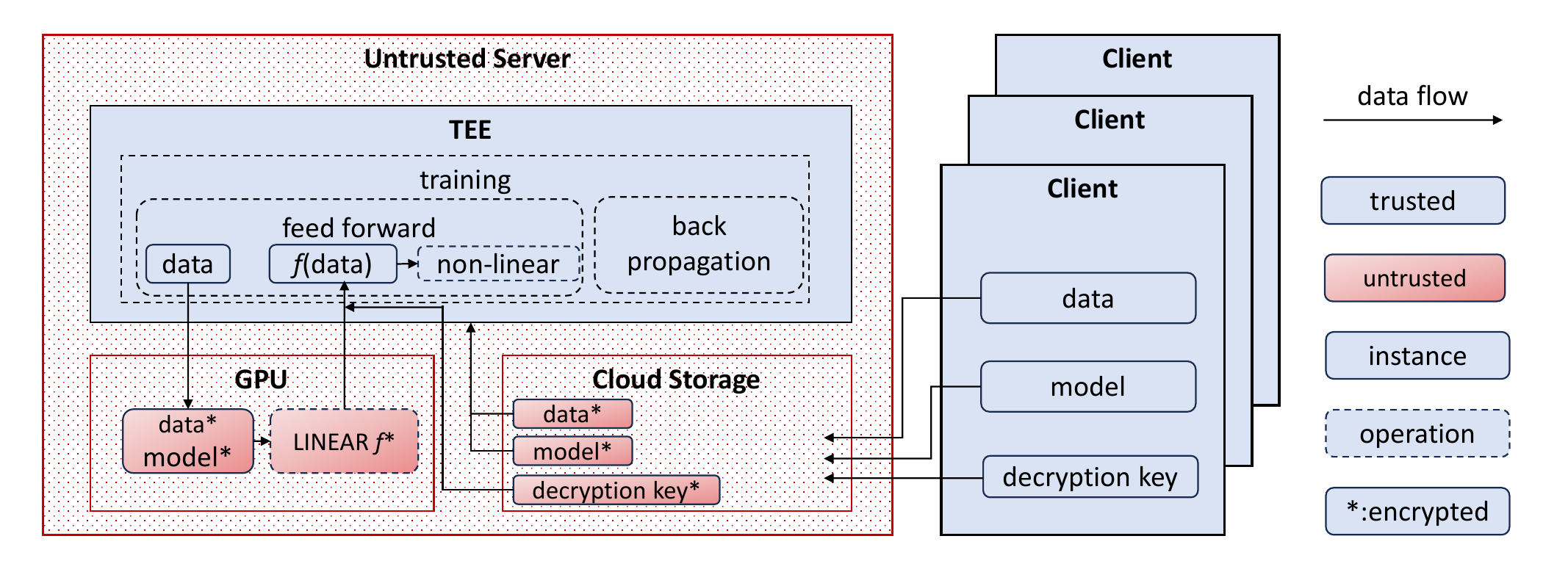
To ensure the integrity of training participants in federated learning, I use TEEs to design a sampling-based retraining verification protocol [2]. The solution randomly selects a subset of training rounds to be reproduced inside a TEE, allowing the server to verify whether participants executed legitimate training on their committed data.
The framework also incorporates secure offloading techniques from my previous work. In particular, I introduce a partial training offloading scheme that allows secure enclaves to offload linear operations to co-located GPUs, protected by lightweight one-time-pad encryption and pseudorandom permutation. This design significantly improves scalability by eliminating the need to perform the entire training process within TEEs. In addition, the framework does not require every participant to possess a TEE because only the verifier operates within a trusted environment. This flexibility broadens its applicability to large-scale and heterogeneous federated learning deployments.
Accumulator-Based Integrity Verification for Federated Learning
Building on sampling-based retraining and secure offloading, I further improve integrity assurance by eliminating the need for retraining [3]. I design a lightweight accumulator that records cryptographic commitments to intermediate gradients throughout the local training process. Instead of retraining, the verifier checks whether these accumulators are consistent with the submitted local model updates.
This commitment-based mechanism significantly reduces computational overhead while maintaining verifiable correctness. By combining TEE-assisted attestation with cryptographic accumulation, the framework achieves efficient, privacy-preserving verification suitable for resource-constrained and sensitive domains such as healthcare.
Practical Lattice-Based Multi-Authority ABE
In this project, we aim to use an efficient ring-LWE construction to improve the efficiency of decentralized multi-authority attribute-based encryption (MA-ABE). We design an RLWE-based MA-ABE protocol and prove its security in the selective security model. Our analysis shows that the protocol improves efficiency by a factor of (N^2) compared with other lattice-based MA-ABE schemes offering the same functionality. Preliminary results demonstrate encryption and decryption times of 28.60 and 15.71 seconds, respectively, when (N = 1024), showing the feasibility of the construction in real-world applications.
We are currently implementing the protocol and plan to release the code as an open-source library on GitHub.
Publications
International Conference Publications
- Li, J., & Yu, S. (2024). Efficient multi-authority ABE from learning with errors over rings. In Proceedings of the IEEE Military Communications Conference (MILCOM 2024) (pp. 963–968). IEEE. DOI
- Li, J., Chen, N., Yu, S., & Srivatanakul, T. (2024). Efficient and privacy-preserving integrity verification for federated learning with TEEs. In Proceedings of the IEEE Military Communications Conference (MILCOM 2024) (pp. 999–1004). IEEE. DOI
- Li, J., & Yu, S. (2024). Integrity verifiable privacy-preserving federated learning for Healthcare-IoT. In Proceedings of the IEEE International Conference on E-health Networking, Application & Services (HealthCom 2024) (pp. 1–6). IEEE.
- Guo, R., Li, J., & Yu, S. (2024). GridSE: Towards practical secure geographic search via prefix symmetric searchable encryption. In Proceedings of the 33rd USENIX Security Symposium (USENIX Security 2024).
Refereed Journal Publications
- Li, J., Zhang, Z., Yu, S., & Yuan, J. (2022). Improved secure deep neural network inference offloading with privacy-preserving scalar product evaluation for edge computing. Applied Sciences, 12(18), 9010. DOI
- Zhang, Z., Li, J., Yu, S., & Makaya, C. (2023). SafeLearning: Enable backdoor detectability in federated learning with secure aggregation. IEEE Transactions on Information Forensics and Security, 18, 3289–3304. DOI